
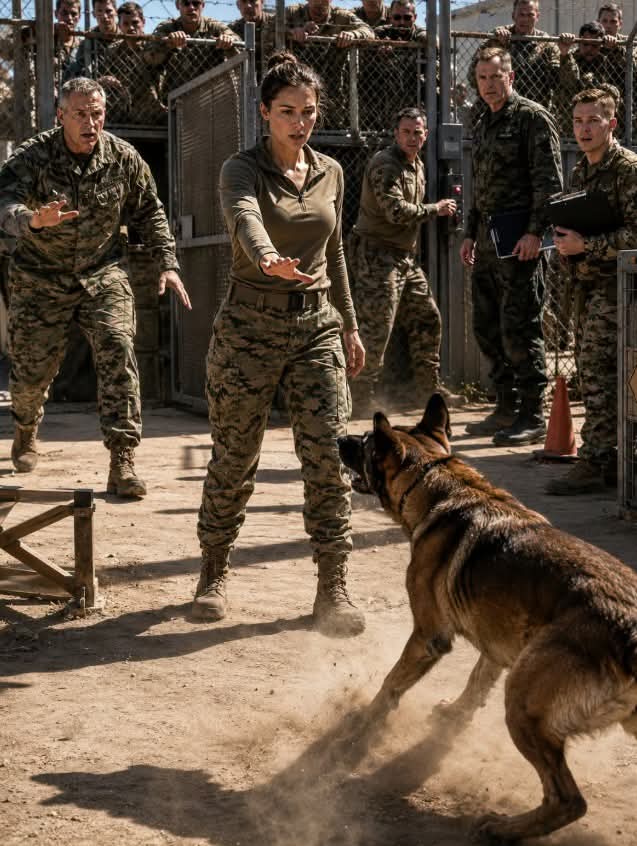
The SEALs Threw the New Girl Into the K9 Yard — Then the “Killer Dog” Heard His Real Name
Part 2
Commander Whitfield ordered the yard cleared.
Nobody moved.
Garrett stood between him and Maya.
“With respect, sir, the dog has demonstrated controlled recognition and immediate de-escalation.”
“He also entered the yard in attack posture.”
“Because your assessment placed an unknown person inside his restricted space.”
Whitfield’s eyes hardened.
“You are questioning a direct command, Master Chief.”
“I am documenting an operational fact.”
Maya watched the exchange without interrupting.
Shadow remained beside her left leg.
His body was no longer tense, but his attention followed Whitfield with unusual precision.
Maya noticed.
“Has Commander Whitfield interacted with him before?” she asked.
Ellis looked uncomfortable.
“Not officially.”
Whitfield turned.
“Corporal.”
Ellis lowered his eyes.
Garrett spoke.
“Answer the lieutenant.”
“I saw the commander near the kennel twice after midnight. Three months ago. He was with two civilian contractors.”
Whitfield’s face changed.
“Enough.”
Shadow’s growl returned.
Maya looked down at him.
“What did they do to you?”
Whitfield left without another word.
That afternoon, Garrett gave Maya unrestricted access to Shadow’s files.
He also placed a temporary hold on the termination order.
“You have fourteen days,” he said.
“I requested four weeks.”
“Whitfield will challenge the hold. Fourteen days may be all I can protect.”
Maya opened the first file.
“Then I won’t waste them.”
She worked without trying to force progress.
The first two days, she did not touch Shadow unless he initiated contact.
She sat inside the kennel and read reports while he rested several feet away.
She removed the metal choke collar.
She replaced the raised food bowl that caused him to flinch whenever it struck the wall.
She discovered scars beneath the fur around his neck—small circular marks arranged too evenly to be accidental.
Electrode contact points.
On the third night, a helicopter crossed the coastline.
Shadow threw himself against the enclosure door.
Maya did not grab him.
She sat on the concrete.
“Shadow.”
He paced.
“Home.”
The private command came from years earlier.
Daniel had created it during their first deployment. It meant there was no mission, no threat, and no person requiring protection.
Shadow stopped.
His eyes moved toward Maya.
“Home,” she repeated.
He crossed the enclosure and lowered himself beside her.
Maya rested one hand against his side until his breathing slowed.
Decker watched from the outer fence.
“You had a command for panic episodes?”
“We created it after his first explosion exposure.”
“His later handlers did not have it.”
“They were never given his original command vocabulary.”
“Why not?”
“Because the program wanted the old bond removed.”
Decker folded his arms.
“You keep saying program. What was it?”
Maya looked through the chain-link fence.
“Rapid Bond Suppression.”
His expression shifted.
“That sounds like contractor language.”
“It was designed to make dogs transferable between multiple handlers. No attachment. No preference. Obedience to anyone carrying the correct authorization.”
“That could be useful if a handler goes down.”
“That was how they sold it.”
“What did it actually do?”
She looked toward Shadow.
“It taught dogs that attachment would be followed by pain.”
Decker’s arms slowly lowered.
The technique used repeated bonding and forced separation. A handler would feed, train, and earn the animal’s trust. Then the handler disappeared.
Another arrived.
If the dog resisted, punishment followed.
The cycle repeated until the animal stopped forming attachments.
At least, that had been the theory.
“What happens when it fails?” Decker asked.
“You get a dog that sees every approaching person as the beginning of another betrayal.”
Decker looked toward the scars around Shadow’s neck.
“Who would approve something like that?”
“Someone who sees working dogs as replaceable weapons.”
On the fifth day, Maya found the original intake photograph buried inside a logistics archive.
Shadow stood beside Daniel.
Her brother’s face had been redacted, but she recognized the posture.
Daniel had been tall and broad-shouldered. He always rested two fingers against Shadow’s collar in photographs, not controlling him, simply maintaining contact.
Maya stared at the image.
Daniel had been her older brother, closest friend, and the first person who understood that Maya communicated with dogs more naturally than she did with people.
They raised Shadow together.
On their second deployment, the Malinois found an explosive device beneath a collapsed stairway seconds before Daniel’s team entered.
On the third, Shadow dragged Maya by her vest after falling debris trapped her inside a damaged building.
Then Daniel died during a raid in northern Syria.
Maya and Shadow returned on different aircraft.
She never saw the dog again.
Her retention petition was denied four days after the funeral.
Too quickly.
Too cleanly.
For two years, every office told her Shadow had been reassigned through standard channels.
Now the photograph proved the dog called Rex was hers.
The name Shadow appeared in the original microchip record.
Maya found Garrett before dawn.
She placed the file on his desk.
“They altered his identity.”
Garrett read silently.
“Why?”
“To erase his connection to Daniel and me.”
“Who benefits?”
“Whoever wanted an experienced combat-bonded dog for the conditioning program.”
Garrett called Commander Whitfield.
The conversation lasted less than three minutes.
When it ended, Garrett placed the phone down carefully.
“He says the transfer was approved above his level.”
“That is the same answer I have received for two years.”
“He also ordered me to suspend your access.”
“Will you?”
Garrett looked through the office window toward the K9 yard.
“No.”
Maya studied him.
“You could lose your command.”
“I have followed unpleasant orders for nineteen years because I believed the system still contained limits.”
He looked at the transfer file.
“Someone took a grieving animal, erased its name, and experimented on it.”
Garrett stood.
“I would like to know who believed that was inside the limits.”
See more on the next page
The rehabilitation continued.
By the seventh day, Shadow accepted Decker inside the yard.
By the ninth, he completed a scent course without physical prompting.
On the eleventh, he allowed Waylon Briggs to hold his lead.
Progress was not perfect.
A high-frequency whistle used during morning drills caused Shadow to panic.
Maya dropped beside him.
“Home.”
He returned to her.
Waylon examined the training speaker.
“That frequency was mentioned in his incident report.”
Maya looked at the device.
“Above twelve kilohertz.”
“What does that mean?”
“It may have been part of the conditioning trigger.”
They tested the theory safely from outside the kennel.
When the frequency played, Shadow reacted.
When a lower tone followed, he froze completely.
Not fear.
Compelled stillness.
Maya’s face became cold.
“They installed control signals.”
Decker stared.
“In a military dog?”
“They tried.”
“Can they still use them?”
“Only if we don’t remove the response.”
Ellis approached later that afternoon.
He carried a folded piece of paper.
“I was the duty officer when Shadow arrived,” he said.
Maya waited.
“The transfer authorization did not use a Navy code. I wrote it down because it looked wrong.”
He handed her the paper.
MAS-7.
Meridian Applied Systems.
Maya recognized the company.
A private defense contractor specializing in behavioral integration, although no public program mentioned military dogs.
Garrett read the code.
“They bid on a classified K9 enhancement contract last year.”
Decker looked toward Shadow.
“He was the prototype.”
“One of them,” Maya corrected.
The room became silent.
“How many?” Waylon asked.
“I don’t know.”
Garrett closed the office door.
“We need evidence before we accuse a defense contractor.”
Maya nodded.
“That begins with Shadow passing an operational-readiness evaluation.”
Decker looked at her.
“You think he is ready?”
“I know he is.”
“You are emotionally connected.”
“Yes.”
“That makes you biased.”
“It also means I know what he looked like before Meridian damaged him.”
Decker considered the answer.
“Then the team designs the test.”
“Agreed.”
“No special treatment.”
“None.”
“If he fails, we say so.”
“If he fails, I step back.”
Decker extended his hand.
Maya took it.
“Seven days,” he said.
That evening, Commander Whitfield filed a request postponing the evaluation for thirty days.
Shadow’s termination date was twenty-two days away.
Garrett read the request twice.
“He is trying to run out the clock.”
Maya looked toward the dark yard where Shadow slept.
“Then we go above him.”
The following morning, she entered Admiral Raymond Carson’s office carrying the transfer code, the altered records, and the career she was prepared to lose.
Part 3
Admiral Carson gave Maya twelve minutes.
She used eleven.
She described Daniel’s death, her denied retention request, Shadow’s transfer, the missing eighteen months, the conditioning scars, and the Meridian authorization code.
She spoke without emotion because the evidence did not require it.
Carson examined the document.
“In your professional judgment, is the dog operationally ready?”
“Yes, sir.”
“Without qualification?”
“Without qualification.”
“Commander Whitfield claims the rehabilitation documentation is incomplete.”
“Commander Whitfield visited Shadow’s kennel at night with Meridian contractors.”
Carson’s eyes rose.
“Can you prove that?”
“Corporal Ellis witnessed it.”
The admiral leaned back.
“What are you asking from me?”
“Allow the evaluation to proceed.”
“And afterward?”
“If Shadow passes, open an investigation into every dog transferred through the Rapid Bond Suppression Program.”
Carson remained silent for fifteen seconds.
“The postponement is denied,” he said. “The evaluation proceeds tomorrow.”
Maya stood.
“I will attend.”
Her heart shifted once.
“Thank you, sir.”
“Do not thank me.”
Carson returned the document.
“Pass.”
The entire platoon gathered at the training yard before sunrise.
Decker designed three phases.
Detection.
Tracking with handler changes.
Controlled protective engagement followed by full-drive recall.
The final phase was deliberately severe.
Shadow’s records showed zero successful recalls after the Meridian program.
A dog unable to release on command could never return to active service.
Maya brought Shadow to the starting line.
He stood calmly at her left side.
No pacing.
No pulling.
No fear.
Someone behind the fence whispered, “He looks like a different dog.”
Maya heard him.
Shadow was not different.
He was remembered.
Decker raised one hand.
“Phase One.”
Maya gave the search signal.
Shadow entered the simulated structure.
Three target compounds had been hidden among strong decoys.
He found the first in forty seconds.
The second in sixty-two.
He ignored the industrial solvent intended to confuse him.
At three minutes eighteen seconds, he sat beside the final target.
Clean performance.
No false indication.
Phase Two required him to track across a quarter mile of mixed terrain while accepting two unfamiliar handlers.
Maya handed the lead to Waylon.
Shadow looked at him.
Then back at her.
She gave the trust signal.
Shadow turned toward Waylon and waited for instruction.
The tracker’s expression changed.
The dog completed the route in eleven minutes without losing the trail.
At the final transfer, Decker took the lead.
Shadow examined him for one second.
Then continued.
When they returned, Decker handed the lead to Maya.
“He did not hesitate.”
“Trust does not require constant physical confirmation.”
Decker looked at the animal.
“Phase Three.”
A decoy wearing a full protective suit entered the yard.
Shadow’s body changed.
Focused.
Powerful.
Waiting.
Maya gave the engagement command.
Shadow crossed the distance and struck the protected target with controlled force. His bite landed in the correct area.
The decoy struggled.
The dog’s drive intensified.
This was the point every report said he could not leave.
Maya spoke one private word.
“Harbor.”
Shadow released immediately.
He turned at full speed, returned to Maya, and sat at her heel.
Four seconds passed in complete silence.
Waylon finally spoke.
“Well.”
Decker stared at the place where Shadow had stopped.
Admiral Carson turned toward Garrett.
“Your recommendation?”
“Full operational integration. Effective immediately.”
“Approved.”
Carson placed his cap beneath one arm.
“Lieutenant Raines.”
“Sir.”
He looked toward Shadow.
“Good dog.”
Then he left.
Decker approached Maya.
“What do you need from us?”
The word us changed everything.
“I need help proving what Meridian did.”
“How many dogs?”
“We start with the forty-seven currently under behavioral review.”
Garrett opened the operations annex that night.
Decker selected Waylon, communications specialist Samuel Prior, and Staff Sergeant Luke Hendricks, who had practiced federal contracting law before joining the Navy.
Maya spread two years of records across the table.
Denied petitions.
Transfer orders.
Altered microchip files.
Behavioral reports.
Meridian’s project code.
Prior searched public contract databases.
“Meridian has four registered awards,” he said. “Three are classified.”
“And the fourth?” Garrett asked.
Prior leaned toward the screen.
“Advanced K9 Behavioral Modification Research. Multi-Unit Acquisition and Conditioning.”
The room went still.
“Multi-unit acquisition,” Hendricks repeated. “They were not waiting for dogs to be assigned. They created a process to obtain them.”
“How?” Decker asked.
Maya already understood.
“Dogs become vulnerable after losing handlers. Their behavior changes. They are flagged as unstable.”
“Then Meridian enters through the review process,” Waylon said.
“Transfers them before termination,” Maya continued. “Renames them. Removes the bond history.”
Prior searched current military databases.
“Forty-seven dogs under behavioral review. Eleven scheduled for termination.”
“Cross-reference handler deaths,” Maya said.
Minutes later, Prior looked up.
“Nineteen entered behavioral review within six months of a handler killed in action.”
No one spoke.
Maya imagined nineteen dogs waiting for voices that never returned.
“How many went through Meridian?” Garrett asked.
“We need the Fort Polk records,” Hendricks said.
Maya contacted Sheila Park, an investigator with the Government Accountability Office.
Sheila had listened to Maya’s suspicions fourteen months earlier but lacked evidence to open a federal case.
Now Maya had Shadow.
A rehabilitated prototype.
A signed readiness evaluation.
A contractor code.
A public program description.
Sheila remained silent after hearing the evidence.
“I need independent verification of the Meridian code and records from Fort Polk.”
“How long?”
“Seventy-two hours for a subpoena request.”
Commander Whitfield learned of the inquiry within one day.
He filed three charges against Maya.
Conduct unbecoming.
Misuse of military resources.
Operating beyond assignment authority.
The allegations triggered mandatory review.
Carson called her into his office.
“These could end your career.”
“They are meant to discredit me before Sheila opens the investigation.”
“That does not make them disappear.”
“I know.”
“What are you asking?”
“Seven days.”
He studied her.
“If the Fort Polk records show nothing?”
“I answer every charge.”
“You are putting your career on your theory.”
“My career is less important than eleven dogs scheduled to die before anyone asks what happened to them.”
Carson closed the complaint file.
“Standard review gives you seven days.”
Maya stood.
“Finish it,” he said.
On the third day, a former veterinary technician arrived at Coronado carrying a thumb drive.
His name was Marcus Webb.
He had worked inside the Rapid Bond Suppression Program.
For three hours, he described the methods.
Forced attachments.
Repeated separation.
Pain triggers.
Sound-frequency conditioning.
Dogs punished until trust became associated with danger.
Webb had refused to continue and was pressured to resign.
“The Fort Polk program was only the pilot,” he said.
Maya’s hands became still.
“Where is the active program?”
“Nevada. Private facility listed as agricultural research.”
“How many animals?”
“More than thirty when I left.”
“Military dogs?”
“Some. They changed acquisition sources after questions began. They started taking police and civilian working dogs, too.”
Decker swore quietly.
Webb placed facility maps on the table.
“They know an inquiry has begun. If Meridian believes the records will be seized, they may move the dogs.”
“Or destroy the evidence,” Garrett said.
Everyone understood what the animals represented.
Evidence that breathed.
Admiral Carson signed an emergency interagency request that night.
The Department of Justice placed the Nevada property under surveillance.
At 6:15 the next morning, Sheila called Maya.
“There are thirty-one dogs inside.”
Maya looked toward Shadow sleeping beside her cot.
“Eleven appear to be military dogs officially listed as transferred or dead.”
The same number as the current termination list.
“But they are different animals,” Sheila continued. “Those scheduled for termination were Meridian’s next group.”
Maya stood.
“Who approved the contracts?”
Sheila paused.
“Senator Paul Drayton’s defense appropriations subcommittee.”
A United States senator had protected the program.
Before Maya could respond, alarms sounded across the base.
Shadow’s kennel door had been opened remotely.
And Commander Whitfield had disappeared.